Friday, August 29, 2014

Astronomy- A Historical Saga: Part 3.3.3

3.3
Johannes Kepler
Italian astronomer Copernicus, Danish astronomer Tycho and after that, comes German astronomer Kepler; All in Europe. This is why; Europe is called the gateway to universal knowledge. Even today, Europe is known as the paradise of knowledge to the learners.
In December 27, 1571 in some corner of south-west Germany, a new age scientist was born in a poor family whose name was Johannes Kepler, a genius who changed the mankind paradigm. His contribution is counted as a very important part of astronomy.
Kepler’s family life was full of sorrows. He was born with poor health. His father was an on-rent-soldier. He was lost when Kepler was young, some say, his father died. His mother was a rude lady and thus, she was insulted by the society and even once, his mother was accused of being a wicked witch. Kepler freed his mother from this blind religious view.
Kepler’s education life was not so good enough, as he was poor. But he was talented and studied against all odds. This struggling hero wanted to become a priest but became an astronomer by accident. Kepler was a teacher in some school of Grudge, Austria. He was not a good teacher as he was as a student.
When he became priest, he was told to make a calendar which can predict the future about climate, politics etc in astrological method. Kepler was lucky (!) as his major astrological predictions about climate became true in 1595 and thus, he became famous as an astrologer. Point to be noticed that in his age, astronomy and astrology were not differentiated.
Once, Kepler was explaining his students about the transit of Jupiter and Saturn. To explain it to them, he drew a complex geometrical image on the board. He made a theorem- the “Kepler’s Theorem”. The Revolutionibus of Copernicus attracted him, because the sun-centered model gave him a divine (!) feeling. Researching on that book, Kepler published his first book, Mysterium Cosmographicum, in English- The Mystery of Cosmos. In today’s scale, the book had nothing special. Kepler sent the book to Tycho and Galileo. They admitted the talent of Kepler, though he had not that intellect that he needed to be an astronomer. One accident changed his identity from a famous astrologer to a famous astronomer. In his book he suggested that there are five perfect geometrical shapes in the structure of the universe- Cube, Quadrahedron, Icosahedron, Octahedron and Dodecahedron.
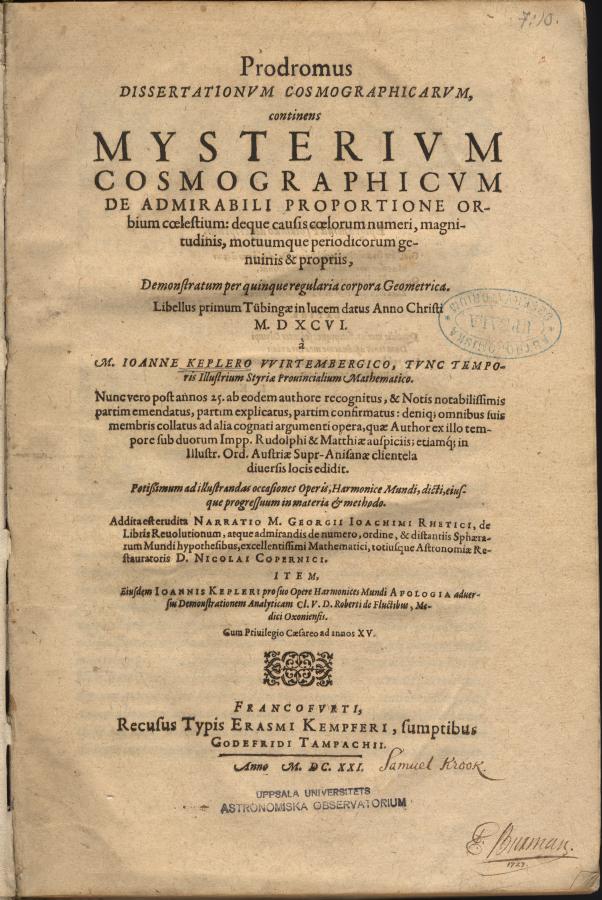
CoverMysterium Cosmographicum
In 1601, Tycho died and Kepler was replaced in his post. Tycho’s death was an accident which gave Kepler the opportunity to become a royal mathematician. Tycho’s observation and research came to his hand. The Rudolfin Table was modified by him. He also analyzed the motion of planets. As he believed in Copernican concept, Tycho’s parents cased on him and refused him to use Tycho’s instruments for research. Kepler handed over Tycho’s instruments to his family but kept his books. Kepler monitored the motion of Jupiter for 4 years. In 1606, he revealed the mystery of Jupiter’s orbit. He found that, the orbit is elliptical. It was a ground-breaking discovery in that age. Kepler bade goodbye to two old concepts- one, circular motion of planets; two, regular motion of planets.
Kepler saw that, the orbit of planet was elliptical and at a focus point was the star, the sun. Near the focus, planet moves fast. On the other hand, far from the focus, planet moves slow. This incident cancelled the concept of circular regular motion of planets.
In 1609, Kepler published his concept in his book Astronomia Nova, in English- The New Astronomy. In this book Kepler tried to give concept of an invisible energy that holds the planets on their orbit. This concept can be referred to the concept of gravity.
A glance of Harmonices Mundi

Cover: Astronomia Nova
In 1604, before publishing the book a supernova was seen in the sky which was named after Kepler as Kepler’s Supernova. Kepler included this incident in his third book Harmonices Mundi which was published in 1619. Actually, this book was the second part of his first book, Mysterium Cosmograhicum. In the book, Kepler showed the relation between the radius of planetary orbit and their elliptic period. Kepler’s formulas describe the phenomena, but can’t explain it. He made these formulas basing on Tycho’s research but didn't know the reason of the phenomena. This is why; Kepler’s formulas can’t be counted as a theory.
He modified and corrected the Rudolfin Table, published it in 1628 and dedicated it to Tycho. This table was a great contribution of Kepler which shows that Copernican sun-based universe model is accurate. Copernicus might have wanted this kind of table as a proof of his concept.

Kepler died on November 15, 1630. He was lucky as he did not face any religious tortures as he lived in Europe. Point to be noticed that, church had no power in Europe that time.

Astronomy- A Historical Saga: Part 3.3.2

3.2
Tycho Brahe
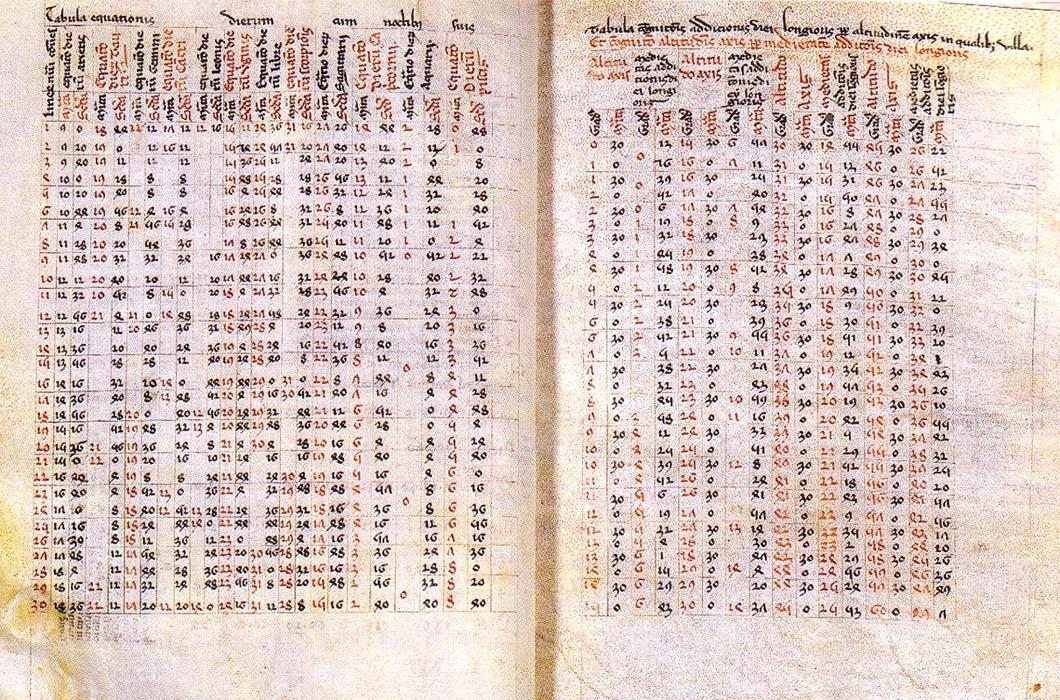
Alfonsin/Rudolfin Table

After Copernicus, thus comes Tycho Brahe- a scientist born in a royal family. His biography is amazing and full of wonders. But that is not the fact here. The main fact here is his contribution for astronomy. We will try to describe his contribution as briefly as we can.
August 24, 1563; Tycho was observing the sky. He discovered the transit of Saturn and Jupiter. Alfonsin Table and Prutenic Table- the very popular journal of that time were analyzed by Tycho and he found that, both of the journals predicted wrong about the incident. In November 1572, a new star was noticed by Tycho in the Cassiopeia constellation. It is called the ‘Tycho’s supernova’. Tycho observed that supernova from different places of Europe but found no parallax of that star. He came to decision that, it is a new star and way too far from here, very far in the sky. Tycho wrote a book on it named as The Stella Nova.
Danish king Fredrick the second became very glad at Tycho for his research. King gave him a lot of money and wealth and gave the power of Hovin Island on Tycho. In patron of the king, Tycho established an observatory on that island. Tycho’s observatory became an astronomical research lab to the world of that time. Tycho did great, but he also did a huge mistake. He thought that earth cannot move. So, he denied Copernican concept and the concept of Ptolemy also. Thus, Tycho made a new model of the universe where the earth is the center of everything and the sun and the moon moves around it and the other planets moves around the sun.
Tychonian System
Tycho had a great talent of observing. There was no telescope that time. But his works are really incredible. In 1588 king second Fredrick died and his son ascended the thrones as his heir. Tycho and the new king had an enmity and Tycho left the observatory with what he had. He moves in to the capital of Bohemia, Prague. He took the post of royal-mathematician of king second Rudolf. He was given the job to correct the Alfonsin Table and it had to be named after the king as Rudolfin Table. Tycho wanted to make the table according to his model instead of Ptolemy’s model as he wanted to prove his model as correct. He employed some mathematicians and astronomers as his assistants. One of them was Johannes Kapler.
In a night of November 1601, Tycho became sick of over-eating in a royal feast. After nine days, he died. But before death, he requested the king to employ Kapler in his post. According to Tycho’s last will, Kapler, who was from a poor family, got the post where Tycho was. Kapler developed a new kind of astronomy basing on Tycho’s observation.
After Tycho, Kapler came and made another revolution in astronomy. He made a sun-centered model again. But he used some unique geometric shapes in his model. Thus, his model became more error-free than ever before. He extended the concept of the universe and made a revolution in the mass view about astrophysics.

Thursday, August 14, 2014

Astronomy- A Historical Saga: Part 3.3.1

3.1
Nicolas Copernicus
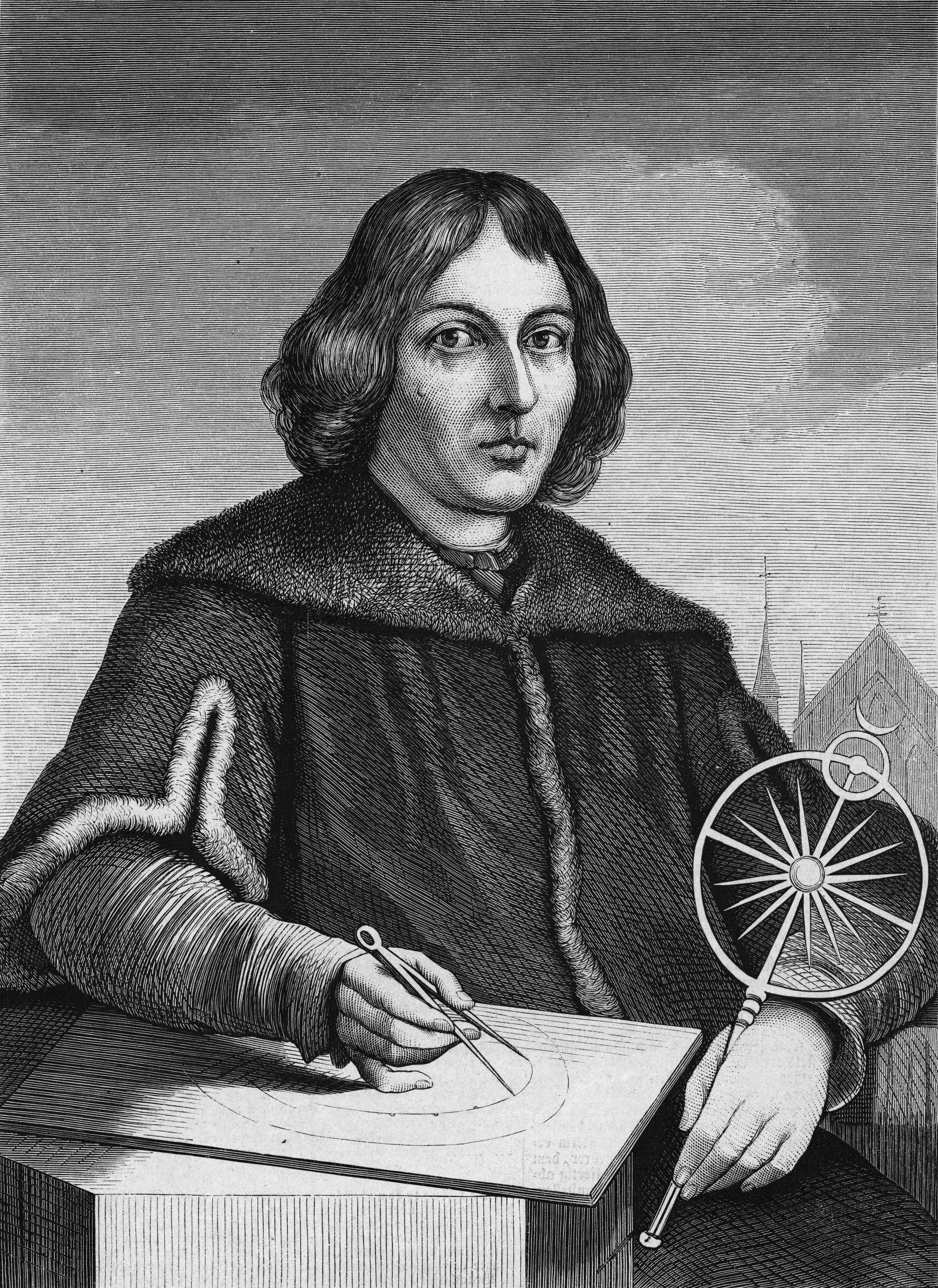
After the religious rage of middle age, science again started to rise up. In 1473 AD, the light of science was again brought by an unforgettable legend- Nicolas Copernicus. He first suggested the modern concept of ‘The Universe’. He is known as the father of sun-centered universe model. He brought a scientific revolution called the ‘Copernican Revolution’. He started this revolution which was later lead by Tyco Brahe, Kepler, Galileo Galilee and Newton. This five great legend has changed the view of mankind towards science. People started playing with science instead of hating it.
The controversial earth-centered model of Ptolemy was totally cancelled. The concept of ‘Scientific Process’ had born. In this new concept of the universe- sun was in the center and everything else moves around it. This is how; Copernicus replaced the place of ancient astronomer, Aristarchus. He just accepted and established the concept of Aristarchus, and sowed the seed of modern astronomy.
Just in age of 24, Copernicus became a distinctive astronomer. He observed that, the ‘Aldebron’ star is hiding behind the moon. Using self-invented devices he observed the sun. He projected the sunlight on the wall and discovered some important information on it. Thus, he became sure that, the concept of Ptolemy is wrong. At the age of 31, Copernicus observed something more interesting. He saw the moon and five other known planets of that time in the summer solstice. This observation not only showed the error of the Ptolemy model, but also clarified that Ptolemy’s prediction was also wrong. Copernicus kept observing the sky. No doubts left that, Ptolemy was wrong. Ptolemy’s concept was thrown to the trash. And another shocking matter about this observation is that, it opened a new door of possibilities for astronomy. Copernicus had to bring a brand new concept of universe- the center-less universe. So he also had to throw off Aristarchus’s earth-centered universe concept.
In 1512, Copernicus wrote an essay which he titled- ‘The Play of The Planets’. In the new universal structure Copernicus showed- the sun is the center of the solar system and the planets moves around it; and the stars are too far away to imagine. Copernicus was an astronomer between middle age and modern age. In one hand, the middle age wasn't ended yet and in other hand, science was at stake. So it was very critical situation for Copernicus to publish his essay as it might hurt people’s religious view. It could be a hazard for middle age. Copernicus was European, and in Europe, Christianity was ruling in full power at that time. Saints killed those on fire who got deviated from the Bible. So, Copernicus kept himself away from publishing that essay.
After many years, two astronomer of Hittenberg University found that essay of Copernicus. They were- Reticus and Reinhold. Copernicus was very old then, Reticus met him. Copernicus showed him the greatest creation of his life- The Revolutionibus. The book, in which, all the results of all the research of his life were written. Reticus requested him to publish it as a book.
Cover: The Revolutionibus
After many difficulties, in April 1543, the book was published. Copernicus was bedfast as he was suffering from heart-disease. That year in June, Copernicus died. But some days before he died, he was given the book. He couldn’t read it. The title of the book was also changed. From The Revolutionibus it became- The Revolutionibus Orbium Quelestium. In the starting of that book, there was an unsigned preface in which it was written that- all the determinations and research included in this book is just a project and may not be true as astronomy can’t assure anything.
This preface wasn't written by Copernicus and he also didn't even know that this kind of preface will be included in his book. The preface cancelled the concept suggested by Copernicus. This incident makes us realize the darkness of religion. A saint named Andrew Osiander wrote that preface. He had a positive motive behind this. Because he knew that if he didn't do it, the book wouldn't be published.
The main five valuable points about the book are just like this- firstly, the earth is the center of the solar system and other planets moves around it. Secondly, the ‘so-called’ sphere of stars is way too far to imagine. This sphere is even very far than the distance between the earth and the sun. Thirdly, the objects which are seem moving in the sky because of the diurnal motion of the earth. Fourthly, the sun apparently seems moving around us, is because of earth’s annual motion. Fifthly, often it seems to us that some planets are moving in reverse. Actually it happens because of their retrograde motion.
Christian Protestants criticized Copernicus for his great contribution. To us it’s valuable, but to the saints it in nothing but zero. Copernicus was lucky as he died within some months when the book was published. But later, another scientific mind named Giordano Bruno who sacrificed himself for astronomy. Bruno considered that the stars are just like our sun, far away from us and maybe there are planets moving around them too. He was killed by the Protestants as he was preaching the concept of Copernicus among people. They burnt him alive. 
What was the crime of Bruno? - Science has never asked this question to the church. Science never had and never has any serious purpose to hurt religions, and never will be. Then why religion always tortures and criticizes science? May be, no one know the answers. Today, Catholic Church begged pardon from us. But nothing comes or goes with their apology. What happened in past, is past. Science doesn't regret past.